Got the Stik with the RCGF-USA 10cc and Walbro WT-80A carb out and she started right up. Needed no tuning, so we are making good progress! She flew wonderfully, and the more she flew the better she behaved. I flew 4 tanks, tuned the high needle a little. She dead-sticked 3 times though.
3 Dead-sticks. Two ended on the runway. The first she leaned out and then died going full vertical several hundred feet up. She did wonderfully up to the quit. She leans out in vertical and goes and goes! She was high when she died, brought her back in just fine. The second I was inverted, then rolled back to upside-up, and she just quit, again good altitude to make the runway. The third was a touch and go, climb out and she quit. I didn't have a lot of altitude to work with and she was 180 off in the wrong direction. Lost altitude getting her around, the wind was tail and too strong to land with it behind her, had to put her down as she lost what little altitude she had, and she disappeared below the infamous edge of the hill. Kept her level and she landed just fine. Flew another tank just fine. Notice no oil all over her! Running leaner.
THIS is what the RCGF-USA 10cc sounds like when its healthy! This one has always run well without any need for tinkering. I have a 13x8x on it now, thinking of trying a 12x8x3, but not sure it needs a smaller prop.
Taxi out. I don't have a way to fly and video at the same time, so... just the taxi out.
The weak knees... and why I had to reset the crash clock. This Sukhoi RCGF-USA 10cc flies amazingly well, and her engine is amazing. But on a simple touch and go her landing gear gave way... again. It's her thing. I have rebuilt the gear so many times. I have always gone with trying to let them be capable of breaking away, but they do too easily, so this time I am hammering down.
She wasn't even going that fast, just touched and gone.
That's a lotta dirt right there... and that's the gear hardpoint all nekkid.
The landing gear hard point ain't so hard...
Built up the base, tons of epoxy. Put a small block of wood on this near end to cap it.
The black bulkhead with the two holes is the back of the gear hardpoint. I put in those two huge pieces of lumber to buttress up the frame, and I will put a couple of vertical posts on top of those. I intend to really bolt this new hardpoint down this time. Those stringers are new where clean as they were broken too. This plane has seen so much work here.
Not pictured now, but I am building a new attachment for the gear and am laminating some plywood for it. That thing ain't coming out... More to come in a few days, have to make the donuts.
One of my absolutley favorite planes was the Mike McConville designed Eflite Pulse XT25e. Apparently, as I review the few blog entries I had on it, I had at least 4. I flew this plane almost every single time I went out, as a 4S. It was fast, maneuverable, stable and predictable. I managed to destroy 3, the last one destroyed itself, and curiously, from a known flaw in the design that I did not manage to provoke before. The wings folded at the bottom of a moderate loop on like the 3rd time I ever flew it. It was a common problem for this plane, likely the small joiner was not enough to adequately distribute the lift forces and the wing commonlty folded in the middle. Eflite would deny this, but why else can an otherwise exquisite design? I miss this one, a lot. Sadly, the main build blog lost its pics in the Great Google Picture Rapture (I deleted a lot of pictures back when Google limited the storage space, not realizing I was also then removing them from the blog posts). What a shame. Simple build, fun to fly.
It was with excitement that I found a flying club aquaintence selling a Hanger 9 XT60, incluing a brand new RCGF-USA 20cc engine, the servos and IBEC (I am hoping its the Tech Aero Ultra IBEC, which knowing Ken, it is).
This is sweet. She is a larger version, is 20cc gasser powered, which if I converted correctly is a big engine for this (I believe that she is designed for a 0.6 glow, which is about 10cc, so 20cc should give great performance). She has a proper aluminum wing spar, so one hopes her classic Hershey Bar wing won't fold. She is pre-hinged, and Ken has done a lot of the build already (pic below), so I hope to be able to plug a receiver in and fly. She would get by with a 6 channel, since she is designed with two aileons (and I would want to program in flaperons, so each their own channel), one elevator, rudder and throttle. I will also need to pick up a wing bag. I think I won't glue the halves together to make her easier to transport. If all goes as planned I will be picking her up tomorrow! More to follow!
This is THE reason I don't fly my 600 helis, nor my 30cc sized electric MX-Bach, that need 6S 4500 mAh batteries...
This is an Admiral 6S 4500 mAh LiPO battery from Motion Rc. This is a good company battery, not a PULSE, but very stable witn consistent quality, and a seller that is exceptional. It costs $80. For one. It may last 2-3 years at best. This is a good competetive price. And its way over priced. For twice that I can buy a 10-15cc gas enging and fly it for the rest of my life for pennies of fuel. Sadly my helis are electric, so I am bound to batteries. My last 6S batteries died out a couple of years ago, so I fly at most 5S, which is fine for my flying style, but I only have 4 of them, and the 600's require two at time in parallel (10S). When those go, I will need to put out about $250 for 4 new ones. This hobby is too expensive for most two job homes in America... This is likely one reason our hobby is dying out again.
The Walbro WA-80 carb arrived yesterday. I am using it instead of a replacement RCGF carb becasue I am curious what effect going from a 1-mm carb to a 7 mm carb might have on letting me lean out the mixture. Performance, efficiency and less oil all over evrything. It is new and unused, but its box had seen better days: apparently it's one of the last ones out there being Walbro no longer makes them. The WA-80 does fit, but there are a couple of unexpected challenges.
WA-80 on the left, stock RCGF one on the right. It's much smaller, but the faces are the same so it is compatible with the 10cc motor. The venturi is about 7mm but it cones down so on the outside air intake it is about 10mm.
The bottom. Very different here, and the first challenge. The throttle is on the opposite side. I do NOT want to move the throttle servo, so the WA-80 will be going in upside down. The RCGF throttle arm is the longer one. Note that it is desgined to be attached to a servo control arm, and can be removed to be replaced 180 deg. The smaller arm is the choke, which I had a manual control arm on, but never needed.
The top. Challenge number two is the throttle arm is not only on the wrong side, but it is designed for a throttle wire to move laterally across the carb, not fore and aft as on the aircraft servo control rod. How to I tranlate the servo fore-aft movement to lateral movement at the throttle arem? This throttle assembly can come out, but the throttle are is press-fit, not screwed on, so there is NO changing it. This about to beome THE major challenge and it will take a couple of hours to solve.
Removed the idle set screw.
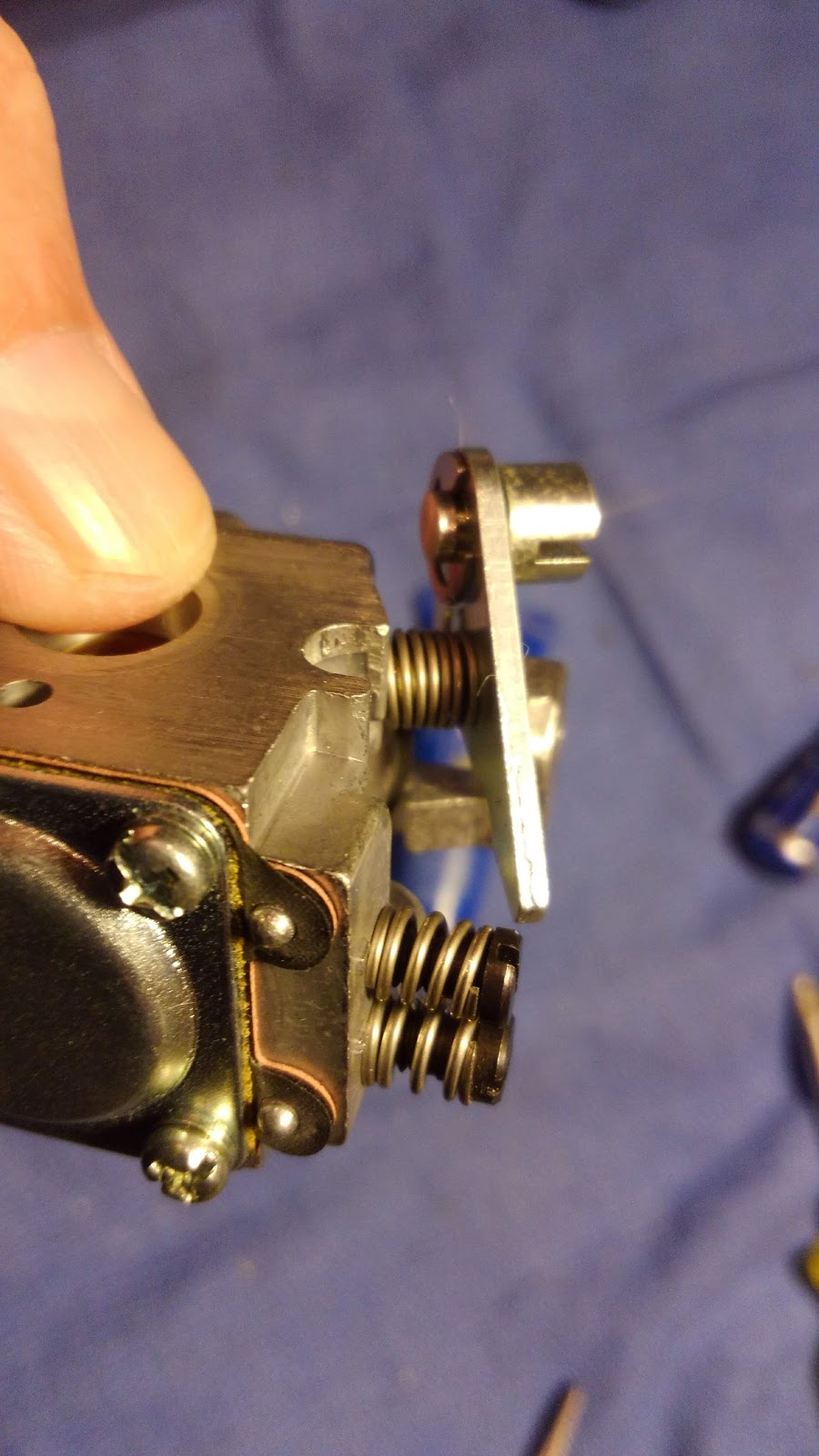
Another view of the throttle arm. That idle screw post is gonna have to go. I Dremeled it off.
Another view of the throttle.
Test fit to see the lay of the land. The wire connector is removed and that large hole is where it was. The hole moves back and forth across the enging, not fore-aft, and the servo control are ain't going to go that way. I thought about how to use the existing linkages to translate the fore-aft to left-right. Nothing worked through the full throttle range. I was going to have to figure out how to attach a control arm on top of the throttle to change the geomety. No way to drill the steel...
I took an epoxy control horn since it is flat and figured out how to best fit it, then trimmed one side, and CA'd it in place. I was able to use two M2 screws and nylock nuts with rubber sided compression washers to futher secure it. It ain't elegant, but it would turn out to work quite well with a little shaping.
One of the screws is through the large hole the other is off one side of the throttle arm.
Another view.
Trimmed down.
Another view.
Engine installed. I would need to trim the servo arm to get full range of motion.
The "underside", installed this is the top. The fuel inlet is now on top, the needles inconveniently on the bottom.
View of the "top" which installed is underneath. Very busy in there.
With the control arm in place. I set it up so that I got range of motion from closed (where the throttle arm would have touched the idle screw arm) to full mechanical open (where the throttle stopped). The throttle in this configuration overshoots full open a few mm, so I need to remove the motor and mark the full open position. I did't think of this until I had installed it, as I had noticed it did this while toying with it while trying to figure out the control arm challenge. I would think it would have hard stops at both ends of the range.
I started working on this after I got home from work at 9pm, and stopped around midnight. This morning, if I get around to it, I plan to remove the engine and mark the real full range of motion, reinstall the engine and see if she will fire up. I will see where the needles are, they are clearly marked HI aft and LOW foreward, and that about 1.5 rotations would be a nice starting point. It comes with no manual.
If this carb is used on RC engines, the control arm would need to be redesigned and I would prefer it be screwed on rather than press fit allowing 180 degree re-positioning. While it would be more convenient to have the needles on the other side, this would require a major redesign. Most of us install the gas engines with the cylinder down due to the size and trying to maintain the scale appearance of the cowl on those aircraft with one. This makes having the needles on the "bottom" and throttle are on the "top" of the engine more convenient. When installed the needles are on top and the throttle underneath. This is without a choke, which is good because lordy there is no room for one.
We'll see how this goes! I will update this post, not make a new one.
UPDATE 1:
Air inlet.
Air inlet, throttle leaflet.
Clean look on top.
A close view of the needles. Clearly marked high/low. I put a touch of silver on a corner to mark their location. Each was about 1-1/4 turns out. Nice place to start.
I checked the ROM and the full that I have takes it from the actual full to closed just fine. Lots of distance, should allow for a nice range of speeds with good resolution.
IT WORKS! IT WORKS!
Listen to that. LISTEN TO IT! That is the sound of success! It took about 45 min of tuning about the default setting to find the sweet spot. When they say "screw driver blade width" adjustments, that's what this baby needed. A little too much or not enough changed everything. The high needed very little tweaking. I didn't have the tach set up, but she idled wonderfully without thrust, and ran WOT clean with that sound I know is her max. Transition was sweet with fine resolution, more than this plane and pilot needs. She idled forever, and it was nice to have to use the ignition cut-off to stop her. I ran her over and over again with the same results, so I am pretty sure she is solid. I need to get her in the air to see how she handles altitude and orientation changes, loading and unloading. I am not sophisticated enough to say, but between lowering the servo speed to one second and this smaller carb, she transitions a lot smoother than before. She is back to being a good engine! I am a happy boy!
I knew she would need to be primed from dry, and couldn't fit my finger back behind the engine to cover the air inlet. I made a little thing and it worked first turns.
Going into position.
Obstructing the air inlet. Only had to do this with the first start, now that the carb is wet shouldn't be a problem, but I will keep this stick in the field box.
Another thing I did notice performance wise, and this was one of the goals. No fuel oil all over the plane. She ran smoother, less four-cycling, and this clean look support that she is running much leaner!
I think this experiment is a success! For production she would need a few design changes, but nothing internally, all easy stuff. This smaller carb may be the way to go!
I get asked this a lot because it takes time and effort to keep up at it and I can be prolific. Besides being a narcissist, I do it for the reasons I stated way back when I started it on October 29, 2010. I really enjoy sharing that I am the average pilot. I am a mediocre flier, a mediocre builder, and a mediocre fixer. I know some stuff, and don't know a lot of other stuff. I started with helis, and have been flying one or another on and off for over 9 years, and still can get embarrassingly happy dancey over getting one to go around in a circle and land.
(This is the first pic I ever posted. I have no idea what heli this is... or if its even mine!)
When we go to the clubs, we see all the shiny, all the skills we don't have, we are embarrassed to try new things because we don't understand them, we are embarrassed by the basic things we don't understand, we are embarrassed when we crash or have near misses. Not just because meritocracies make us compare ourselves to others, but also because the others often forgetting their own struggles, can be unknowingly harsh to newbies, house proud. Everyone else seems to know what's going on and got skilz. Most clubs have a Bell Curve of member personalities, but it's not always evident that most love to share and teach. And every club has "that guy" that flies everything 3D, that guy who knowns the tech, that guy who builds marvels. The point is, where do newbies hang out, and who represents them?
Me. I am "Joe Schmuckatelly", the average guy. I am clever, can solve problems, understand how airplanes fly. But I came into this knowing nothing about RC. I had flown three U-Control 0.049 nitro planes as a kid, but I didn't understand them as I had no one to teach me. I started because I like helicopters and bought a Syma 107 (second pic) and loved it. I wanted more. I wasted a lot of money because I had no idea what I was doing and bought the wrong equipment. I quickly realized I probably needed to learn how to fly RC in general, and bought a Spektrum Dx6 and a cheapo foamie Cub from an US Chinese vendor, immediately putting it in a tree. And I started teaching myself, I started experimenting. I learned that one could join a flying club, and learn how to fly from some really great guys who loved this sport more than their mommies. I had taught myself a lot, and was learning so much in just a few visits at MCRCC, my first club, and I got hooked. These flying monkeys literally got me.
I made a promise to myself that I would blog my successes and my failures, everything. I wanted to share that everyone first learns to move the pawn, and that most of us are mediocre and that is just fine. I wanted every persons to know that we are all making this up as we go along, that even pros shank one into the ground on a regular basis, that the hobby is "more fixing than flying", and that they were right on track with everyone else. I wanted to share that the hobby is for everyone, not just the 3D stars. That "276 days since my last crash" counter is so high because I didn't fly much last year, and winter came. Usually it's about a week. Don't be impressed. If you aren't crashing you are trying hard enough.
So read. Enjoy, and realize we are all doing just fine.
I took the Stik out to the garage today to see what would happen. In my last post I noted that I had thought I found the sweet spot for the idle, albeit high.
Recall that the carb kept needing tuning every time I took it out. Recall further, I screwed this engine up when I rebuilt it trying to get better performance, when it already was fine. It was my first RCGF, a few years old, and needed a cleaning anyway., so I rebuilt it and the carb, and it's never been right since. Joe Nelson of RCGF, and I are sure it's the carb.
Well, the carb went back to its antics and ran great WOT and most of the time at half, but idle dropped to a high idle probably around 3500, then would slowly step down and then stop over aminute. Am I crazy thinking an engine should be able to sit at idle indefinitely? In my last post I noted I purchased a Walbro WA-80 carb, which is no longer in production. I found two new ones at about the same price on eBay. On Flying Giants a poster noted that a smaller carb works better for these small engines, so instead of the stock 10mm, the WA-80 is about 7.1 mm. They note far better performance. So I took the engine off the airplane, and removed the carb. As soon as the new one gets here I will install and put this thing back together. I can't wait to get this engine back to it's flying performance!
I also slowed the servo to about 0.7s, and honestly, it provided a nice smooth progression from idle to WOT. I may do this on all my gassers. It lows the transition in the carb preserving the vacuum, as opposed to jamming it forward and losing vacuum causing the engine to lean as you need more fuel.