The flying monkeys got me...

Helis, Fixed Wing, RC Sailing

AMA 957918

Pirate Kid Skeleton by RadDezigns.

Wednesday, April 13, 2016

Worst engine install, ever!

It's just shy of 3 am... The white face cloth is coated with the carbon fiber that was all over my face, in my boogers, densely embedded in my t-shirt.

I went through a couple of sets of engine side bar mounts getting the engine in the Spitfire. The problem isn't the engine, it's how they built the motor box. It's pre-drilled for several orientations, and all the mount holes have back nuts in them. This limits where you can drill custom holes. Add to that they decreased the available space on the front of the box by putting wedges on either side. Between these two issues my choices were limited, and I ended up Drexel modifying the mount bars to fit the engine. Hence, covered with carbon. I used larger arms to compensate for the material I removed. It's plenty strong.

Why did I stay at this all night?  Really? You have to ask? It was an engineering problem, and there was no way (thumps chest) I wasn't going to solve it.


You can see the Dremel marks and mods.


Its came out pretty nice, after all that. The real challenge will be figuring out how to set up the throttle and choke control rods... more on that later.

Time to sleep... let it go.

Tuesday, April 12, 2016

Sonuvabitch...

When I built my first eFlite Pulse XT 25e I read about problems with a wing spar that was too short, allowing the wings to terminally fold up in flight, destroying the aircraft. I managed to destroy 3 of them over the past several years by other means. Until today... when I lost my 4th one to that foretold fate.

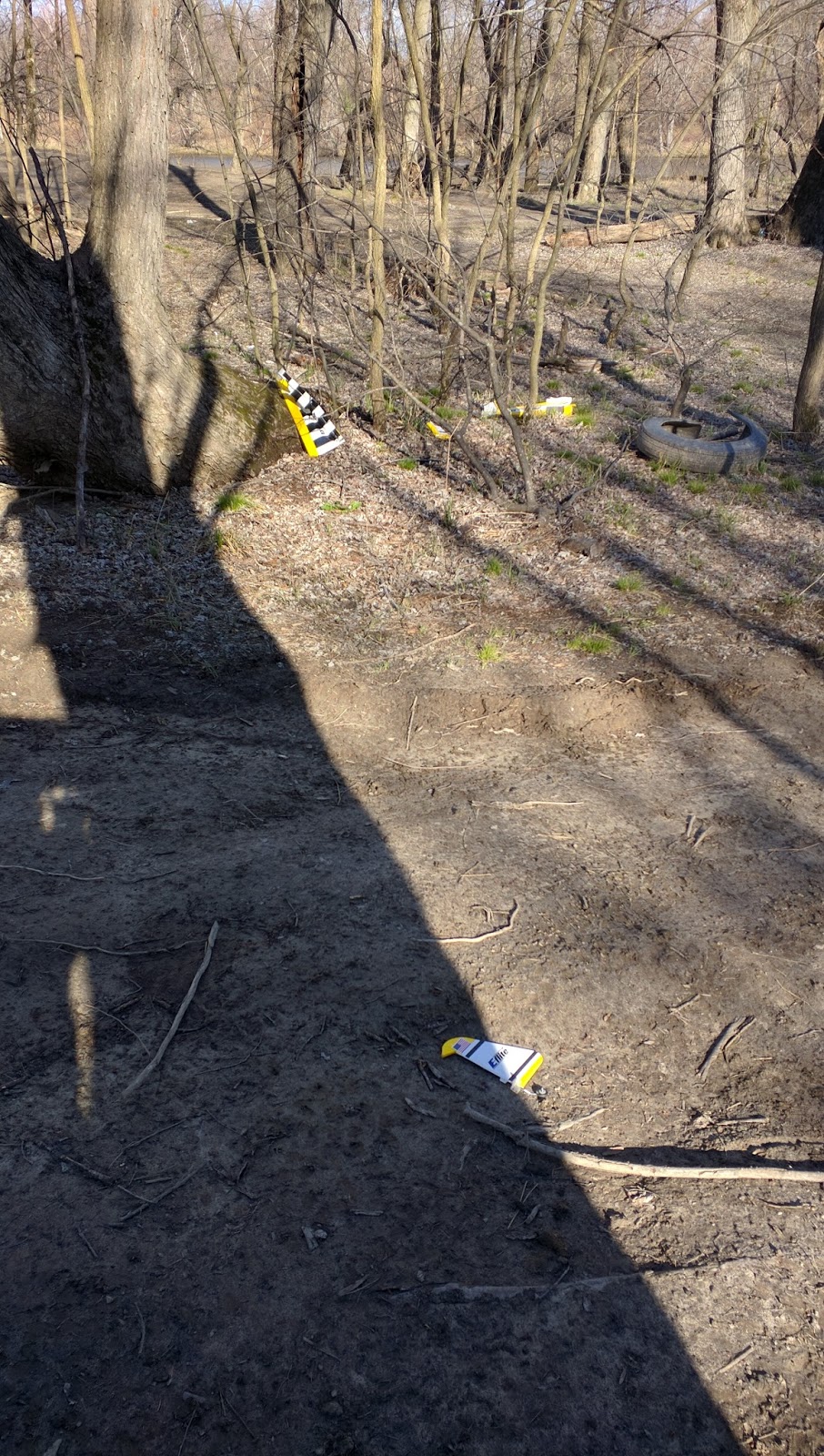
It was a bit gusty, I took off, climbed out, felt out the winds a bit, and did a loop. There was an explosive crack, and her wings folded, came off the fuselage and she fell 150 feet into the woods in several disintegrating pieces. One of the wings fluttered down, and landed in the top of a tree, the other fell to the scene of the crash.

I am rather disappointed. I don't think I will replace her, which really upsets me. This aircraft was on of my favorites...

Links to past posts of my various eFlite Pulse XT 25e.


In the woods, the site of the crash of the main fuse and one wing.


Dammit....


Waaay up there, the other wing.


A close up. Skewered.


We recovered the wing spar... half of it. The spar is about 3" long , runs in the spar joiner: the piece of wood that makes up the spar slides into the box in the wing, the remnant of which I am holding. The spar ends where that little piece of wood is sticking up just beyond my thumb.  There just isn't enough spar to take the forces, and as so many others found out, it collapses given the right setting.


We threw away anything that didn't have electronics in it. This is all that is left.


DC Power from my 2012 Lexus CT200h Hybrid 12V Battery

UPDATE: Added a fuse, changed to lower (thicker) gauge wire.

After thinking about doing this for a couple of years, and coming up with ideas that sounded right but with good advice were abandoned, today within a hour I have DC power to charge flight batteries using my iCharger 208B!  I normally drive the iCharger using a Junai 350 watt power supply. This was so incredibly easy, from accessing the battery, to making and installing the tap.

I was given some simple advice by Ted Ede: don't use an AC inverter only to invert it back to DC. Geez... that makes perfect sense.  So today I found the 12V battery in my CT200h. Tapping this will give me power to charge flight batteries at the field. I can leave my car "running", and it will let me use the 12V, battery, the car's computer will urn the gas engine on when needed to charge it keeping it alive. The amount of charging off my 20A max iCharger is limited only by the gas in my tank.


I went to Lowe's and picked up some flexible 14 AWG wire, red and black, and a pair of terminals. I used my soldering torch and used the same technique I use to solder my EC5's, heating the terminal and filling it with solder and setting the wire in it. I shrink wrapped it.


Using a female banana plug that fits the DC male plug on the iCharger 208B, I soldered it to the other end of the wire, about 54", and shrink wrapped that. I repeated this on the black wire, and encased them both in 1/2" cord wrap I picked up at Harbor Freight.


The CT200h has two batteries. The Drive Pack, which is a ginormous LiPO (the large rectangle in front of the gas tank), and the small 12V lead-acid battery (red square). It is found by opening the spare wheel compartment under the back deck, removing the right back corner floor panel (lifts easily, exposing a small storage space). This exposes the 12V battery. Remove the back plastic panel (also easily snaps out) and the entire battery is exposed.


The floor panel removed, exposing the 12V battery in the right back well.


Removed the back plastic panel, exposing the negative terminal side of the battery. The car's connections are secured with bolt on terminal attachments. I loosened them, removed the nut, being careful NOT to cut the power, attached the terminals on the wires I made, and replaced the nut.


Both of my installed terminals tails point to the middle of the battery so the wires converge in the middle. I used a wire tie to the metal battery strap that runs across the top of the battery.


There are two openings in the plastic tray that covers the battery and provides a small storage space. I flipped the cover over and slightly enlarged the opening allowing my tap wire to come through but still be snug.


In this pic I have replaced the plastic floor cover, and you can see the storage space. Note the EC5 connector.  I used a female EC5 plug to house the two banana plugs, being sure to keep + and - , and super glued them. I had to Dremel down the end of the EC5 connector to allow the male plugs from the iCharger to close and fit snugly. 


Here's the terminal tap coming out from under the floor panel.


The styrofoam tray that covers the spare and holds the First Aid kit and some other small crap is put back in place. The folding cover that makes up the rear deck goes over this.


Turned on the car, and plugged in the iCharger. Voila! DC power to my flight battery charger!

I will post some pictures of the charge station in use as soon as I can.

Monday, April 11, 2016

Jerry Gollot, old friend, fly buddy...I miss you.


I learned today on visiting my old club's website, MCRCC in Gulfport, MS, that one of my friends has died. Jerry died on March 24, 2016. Jerry was a true southern gentleman. I loved him, and he was one of my first fly buddies. He taught me how to be an aviator, how to teach, how to be a club member, how to be a good man despite the few assholes at the club, and though I won't admit it publicly, he taught me to like some conservatives... My thoughts are with Sandra, his lovely and loving wife, and his family.

Jerry taught me how to fly. (Ron Johnson taught me how not to fly... just kidding!). He took me up with my Alpha Sport 450 on a buddy box on my very first day at the field, stuck with me every time I showed up, and had me solo with confidence shortly thereafter. He was my first "pusher' in this lovely addiction we call RC flight. He was one of the original Flying Monkeys. He taught me not to be afraid of nitro planes. He was always present, and he always helped. Always. 


I miss you, Jerry. I really do.

(Dammit Kenny... you should have called me).

Sunday, April 10, 2016

Phoenix Spitfire Build Update: Days 1 and 2


I started the Phoenix Models Spitfire Mk2 build the other day, as the parts have all arrived. Its a slow start. I've been excited about building her, but I've been busy...


DAY 1

On the first day I wasn't very motivated and just did the aileron and flap installation.


It comes with all CA fiber hinges. I planned to use all nylon hinges, but the fit in the flaps box was too tight... The space required by the nylon hinges, even recessed, was too much, so I had to pull them and use the CA hinges on the flaps. I taped the hinges.


Installed, both wings done, called it a day...


DAY 2


I used Hitec HS-485 HB Karbonite geared digital servos on the flaps, saving me $50. I had them on hand from some other build/crash. I generally like all metal gear servos on gassers, but I think having the MGs on all the control surfaces is important, but I can get it away with them on the flaps. Tactic X47MGs on the control surfaces and for the throttle.


I noticed that there were pre-lasered holes to secure the servo cover, so flipped them over and drilled the holes for the small screws that secure them in place.


Be aware there are two different sizes of screws, long for the ailerons, short for all the others. I hate these kinds of control horn installations. If you don't get the drill pilot holes exactly straight, getting the backplate to screw in is challenging. I managed to get about half of them to work out first try.


The long screws come out a little long so I Dremel'ed them short.


Protect with a couple of layers of masking tape.


I followed the design specifically. It makes for a very short aileron control rod. The stock control arms that come with the Tactic servos are just barely long enough, and I didn't have longer ones.  I used longer ones on the Hitec servos on the flaps as I have them.


Installed and done! I set the flaps up as closed at neutral. I've not set these up before, my only flap experience being with flaperons. Once I get the receiver in line and start programming the transmitter (Spektrum DX8) I'll know more. Pointers welcome.


I am not a fan of mechanical servo driven retracts, mostly because my experience with them on the rare plane I have had them on, well, sucked. So I replaced them  on this model with electric ones. I LOVE the way they sound in motion! The struts themselves are from the stock mechanical gears. I mention this to draw your attention to the wheel cover attachment that is closer to the wing; notice that its divided. I had to do this to allow it to retract and not run into the retract unit keeping it from closing all the way. I had to Dremel a little of the wheel box to get the retract to fit properly. These struts have a tendency to fall off, so I will go back and Dremel a notch to allow one of the set screws to hold the gear more securely.


When retracted I noticed that the strut wheel cover doesn't close flush. There is no way to address this as the wheel is firmly seated against the well, which is in turn directly flush with the wing. I looked at pics of others online, and even with the original mechanical retracts this is how it comes out.


All in all they came out nice. My first time!

The wings are each done, and next I will join them permanently. Then I can get on to the fuse and the engineering installation. This is coming along nicely!


Phoenix Models Waco


As soon as I can find one, this is likely my summer build. The Phoenix Models Waco (PH152). I think I would build it with an RCGF 20cc gas engine.  I love her classic lines and history, much like my love for all things Stearman.

Saturday, April 9, 2016

Back to Two.


I have flown her more with the 3 blade prop than with 2. She seems a bit mushy with the 13x8x3. Today flying she didn't have the thrust I needed when I needed power , although she flew amazingly. So I have changed her back to the 2 blade 14x8, and we'll see how I feel.  I love the look of the 3 blade! I need to find a black prop...