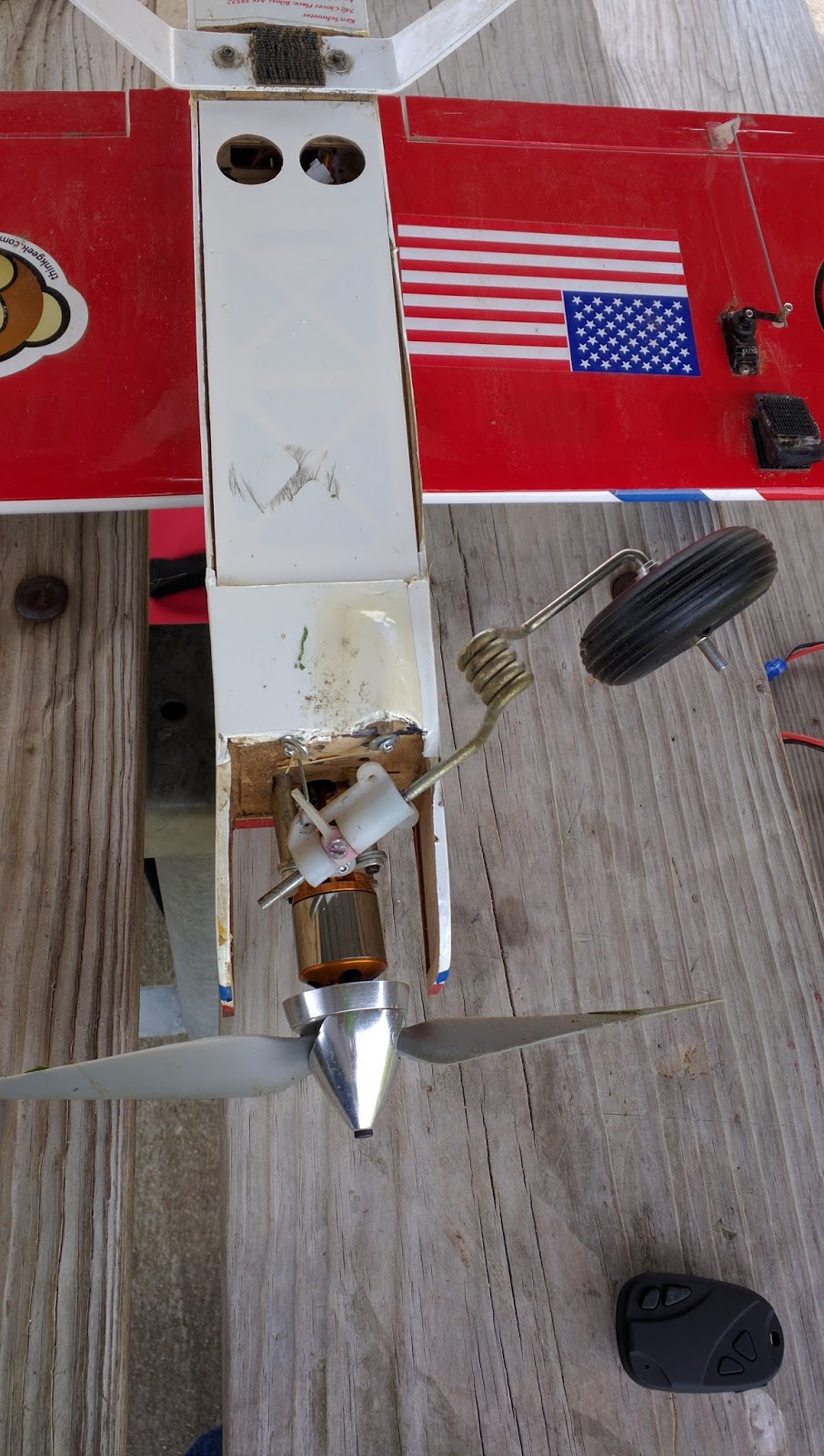
I won't be buying another Spitfire, no matter who makes it. Second Maiden of a Phoenix Model Spitfire brought down by an odd occurrence. It is simply fate. For me, the Spitfire is cursed. I think I expected this as it did not surprise me that it crashed, and I am kinda unaffected by its demise.
I lost my first one a few years ago in an accident at the end of the maiden flight, it clipped a tree coming out of an intended stall. A year later I bought another one, same model. It sat for another year, new in box. This spring I decided to just do it, and built another beautiful airplane, this time with an Evolution 10 cc engine. This entire saga is blogged out here in earlier posts.
So today I took her out to the field in fine conditions to maiden. Here's how it went down, literally.
Gorgeous Phoenix Models Spitfire with 10cc Evolution Gas Engine.
I had a feeling since the day I bought the ARF kit that there was a bad omen about it.
Pre-Maiden Walk around, started and running sweet! Controls surfaces fine, run up fine.
As Nick took the camera from me to video this maiden, he commented that doing so was itself a bad omen. A bit of over rotation on takeoff, recovered started to turn and the engine RPM drops...then it recovers within time enough the inertia let her restart: she had gone into fail-safe mode. The Fail-safe position is ignition killed. Fail-safe is set up when you program the transmitter for a model, and set what it will do if the signal between the transmitter in my hands and the receiver in the aircraft is lost. Usually controls neutral and engine stopped, to prevent it flying off. In this case a momentary "Brown Out" of signal loss is quickly recovered by the software, but by then the aircraft was in a stall spin and it was over.
Nick is noting that at the crash site immediately when we arrived, the satellite receiver was fast flashing, an error code usually meaning "bind" is lost, the unique connection between the aircraft's receiver and my transmitter. Given what we saw, what I experienced (no control) and this blinking receiver, we are confident that she browned out during climb out, she stalled, spun, and control was impossible.
How we found her.
From the other side, before touching her.
Moved the wing to disconnect the flight pack battery.
Goodbye, Spitfire... May you rest in pieces.
So what do I do with an entire fuel/engine and electric system for a 10 cc airplane? I am confident I will NOT be getting another Spitfire. I am thinking Corsair or Zero... For now, I am just leaving it on the floor and enjoying flying my other planes.
My luck with the Phoenix Spitfire has been dismal. First one nipped a tree on its maiden after luring me with its ease and beauty of flight. Took me a couple of years to get over that. The second one I killed shortly after takeoff most likely a stall, possibly related to a radio issue (yeah, I stalled it, blinking receiver light be damned). After the second one I considered myself cursed as far as Spitfires are concerned and swore to never buy/build another. Loosing one after another on maiden flights was too much for a man to bear.
Well, today I have done a thing, and I cannot undo it. I ordered another one, the same one, from Tower Hobbies, the Phoenix Models Spitfire. How can I not? I kindled two airplanes lately, so need a replacement, and this is such a beautiful machine and model! Credit is a terrible thing for an addiction... I also picked up a new pair of the servoless retracts from Hobby King I have used twice before. I like these. I have to modify the wheel wells a bit, but this time I am going to let them stick out rather than chisel down the hardpoint. I looked at using the mechanical retracts and a retract servo, but have heard nothing but trouble from these: the servo from Hitec, my favorite servo company, is a full 180 degree non-limitable servo, so not sure that would even work and it has a poor reputation. The other is a Spektrum retract servo that is adjustable, but has barely a better reputation and is NIS until next month. Screw it, went with the electric servoless ones. The other electronics and servos will come from the dead brethren.
I have two engines for it. The one that has been a pain in my ass is the Evolution 10cc, that first "flew" in the second doomed Spitty. Not comfortable putting it in the new Spitty given the recent trials I have had with it, even though it was once again running great the day of the crash; it still has the stink of the second Spitfire crash on it. The other engine is the RCGF-USA 10cc that was on the Stik. It took quite the header last week in the destruction of the Stik, so I don't know if it will even work, if the shaft isn't somehow damaged. But I think that is the one I am going with, its a better and more reliable engine, has the power, and doesn't have that torpedo muffler coming out of it.
I think too I will build it with a 14x8 Master Airscrew Scimitar blade, rather than a 3 blade, just to get things right. On the ground statically the Spitfire looks wrong with a 2 blade, but its in the air performance I want, may go to a Master Airscrew 13x8x3 later.
So I am excited and look forward to the third attempt!
Amaadur Rahman, a fellow RC Pilot from SNHFE in Merrimack called me a few weeks ago and told me he had been given a VQ Models P-51B Mustang airframe that was in good condition (the wings actually measure 61 inches). It was too big for him to transport, and he thought I would enjoy repairing and setting her up, so he gave it to me! Thanks, Amaadur!
It is in pretty good condition. I am going over it carefully and am trying to keep my costs down. I have on hand a Hobbywing 100A ESC, and a HeadsUpRC 5065-04 1400 watt motor (at VQ Models estimated 7 lbs AUW, thats 200W per pound. My other choice was a 700W motor, and ain't nobody got time for 100W per lb. But that max watts is likely on a 8S battery, and I am flying it 5S, so it will be interesting to see how many watts it ends up drawing). I also have an Orange RX 3 axis stabilized receiver, brand new.
I want all metal gear, digital servos, so today I ordered 4 Corona DS329HV Digital Metal Gear Servos, and a Turnigy 5A 6V SBEC. I have 4 5S 4500 mAh batteries that may need replacing, and one 6S that likely does need replacing, and they fit. Someday I will, but once I know what she likes. I am also replacing those ugly fixed gear for retractables. I have the same servoless retracts I used on the Spitfire, and today ordered a set of struts that are for the Spitfire as this about the same size, from Tower Hobbies. They are updated from the ones that came on my Spitfire and are rather cool looking.
Today I started on the fixin' up.
The model is in pretty good shape. I can't match the stock cote, so I decided that I will put D-Day stripes on that right wing.
Its a sign that the pilot came loose, and I had to re-install him. The canopy came off easily and he's now sitting proud.
I wanted a bigger tail wheel, so I swapped it out.
The cover was on wrong and wasn't flush, so I fixed that. The tail wheel was loose on the turn thingy, so I changed out the set screw for a screw-screw and snugged it up as best I could. Leaving the weights on for now.
I rebuilt the cover and the doors and coted it. Snazzy.
Curiously there is no vent. Electric aircraft, especially one with a huge motor and ESC need a lot of airflow and most have an aft vent to allow flow-thru of cooling air. So I decided I would cut a vent hole and use a vent cover from an Eflite Pulse 25XT that I painted. Marked out the opening.
Opening made. There is nice continuous airflow, but I will make an opening in the cowl under the prop.
Epoxied for strong hold.
Vented.
The wing-fuselage cover is broken and I wasn't sure how to fix it...
I decided to use foam and wood filler.
Trimmed a piece of painters tape to mark the curve.
This is the dense wood filler I am using. I don't want to fill the entire space with it, so trimmed some foam...
And stuck it in the hole.
Then filled it with wood filler. A few hours later I light sanded it, and this weekend I will finish it. I am hoping the silver paint I have is a fair match. Its a warbird, it doesn't have to match. Not sure if it won't fall off as it won't flex well.
I installed the motor. Pretty much fit the stock holes.
I epoxied the battery tray (behind the clamps) as it was loose, and made a small cross piece to mount the receiver, here being epoxied under the clamps.
That's pretty much it for today. This weekend I will finish off that wing cover and make the vent opening in the cowl then install it. I will start repairs on the wing cote and put those invasion stripes on the top, and install the retracts, and when the struts come in those too. Same with the servos, the SBEC, and the receiver. They should all be here in the next couple of weeks! I think she is going to be a great flier.
I thought that I was nearing the end of the Spitfire #3 build, but during the engine run-ups the post-crash RCGF-USA 10cc I just didn't like the sound of the engine, and she didn't seem to get up to full RPM/power. I found the following thrust results, average of 3 measures of static thrust, the aircraft weighs 8 lbs dry. Using a Thrust to Weight ration of 0.7, the plane would fly fine with 5.6 lbs of thrust (I couldn't find any other estimate of Thrust to Weight for gas):
14x6x2: 5.4 lbs
13x6x2: 4.2 lbs
13x8x3: 4.4 lbs
She just doesn't sound right. I am not confident the bearings, especially the front one, are okay, and I think she should produce more RPM.
The spark plug stripped, I think it was coming free during these run ups, and afterwards it just came loose, and it wouldn't tighten. I will be sending this engine to Joe Nelson at RCGF-USA to take a look at and see if he can solve the problems he finds. I suspect she will need a new cylinder head and bearing(s), possibly a new spark plug.
In the meantime I am considering taking the RCGF-USA 10cc from the Sukhoi and moving it to the Spitfire. That engine runs perfectly, is the same exact engine, and would be a simple exchange. When the repaired engine comes back I can put it in the Sukhoi. I am stalling on that because it runs and works perfect in the Sukhoi and I don't want yo screw around with that. Patience...
I got 2 years and hundreds of flights out of the Turnigy 6V NiMH Reciever and Ignition packs. The ignition pack failed, but I am replacing both.
This put my troubleshooting of the Stik's 10cc RCGF Engine on hold. I replaced the two batteries with the same packs, but have to wait about a week while the FedEx guy rides his bike from Oregon with them.
The Hangar 9 10cc Ultra Stick has her balanced prop on and is ready to go!
Got the cowl on the Phoenix Spitfire, and checked her CG: SPOT ON no changes necessary!
Looking good. I am ready to give this, my third Phoenix Spitfire a run for my money. I have had two previous ones perish on maidens. The first when I clipped a tree coming out of an intended stall, the second when she stalled on takeoff and torqued into the firmament. I have no doubt this one is the one.
I have been working on this RCGF 10cc engine for a few weeks on the Spitfire. I rebuilt the carburetor and did a thing fixing the stripped sparky with an adapter. I got it running finally today! Decent albeit slightly high idle, nice smooth acceleration, and a powerful WOT with 5.2 lbs thrust swinging the 14x6 Master Airscrew! And then all of the sudden I couldn't get it to run. What the heck? Wait, no compression? Turns out the pressure and heat blew the stainless adapter out of the crappy metal cylinder of this first generation RCGF engine. This problem of soft metal has been addressed in the current RCGF-USA 10cc engines.
Found it finger loose. Tightening it was unsuccessful, it just kept slipping.
Stripped...
So... I have a good carb on this engine, and a good cylinder on the other that has a carb problem, I hope. I swapped the carbs, and am now using the new cylinder and crankcase Joe Nelson gave me. One of the carb flapper valve plate carb securing holes on this new engine stripped with no real force! Maybe that's why the "carb" was bad? So, I went back to the failed cylinder, pulled the flapper valve adapter, and swapped it out. The bad cylinder is now a parts farm... which I hate, so eventually will rebuild it. Went ahead and replaced the carb gasket.
So... brand new cylinder and crankcase, swapped flapper valve adapter plate, and the original good carb, installed. Got late for running an engine, so will have to wait until tomorrow. Disappointed, that orginal was running almost perfectly today! Tomorrow I hope to finally get the Spitty up and running and flight ready!
Last night I essentially finished the third Spitfire. I installed the fuel system, engine, and the electronics, the wing is joined to the fuse and everything works!
Rather full upper equipment bay. Fuel tank forward, reciever on the starboard side, 2S 2300 mAh LiPO on the port with the mai power switch on underside of th throttle switch. Snug and cozy.
I really like the simple switch from Hobby King. Its electronic so will fail "on", and has a nifty multicolored battery charge detector. On line in, one out. I hadvto trim of the handy flanges. Great price even if shipping was steep, almost the same price as the part for the guy on the bicycle speed delivery.
Another view of the equipment bay, looking aft.
The cowl is done, the engine and muffler holes cut out and it has been fitted. Needs to have needle access drilled out still, but its done. Leaving it off for the first engine start to make sure there are no issues. That's really all that is left, first fuel, first start and run up!I do need to find some letters for the side, didn't like the ones ai got for being too narrow (ordered them online, didn't get a good look). I'll put my initials on either side of the fuselage rondels.
I will use the RCGF 10cc gas engine, the newest one with attached carb and a choke, and attach a mini-tachometer. It will have a 4 20cc gas tank. It will have an RC EXCEL optical remote cut-off I install on all my gassers. I will install a Star dual power switch, and Kazu fuel dot and vent. I purchased two 6V NIMH reciever/ignition packs from Hobbyking. I plan to use a Master Airscrew 13x8 3 blade prop I have on hand, and ordered a Dubro 3 blade 3 inch Spinner.
I had purchased electric landing gear retracts from HK as well. I bought them as a pair, but can't find them. They weren't very expensive, I think less than $20 a pair. I just don't trust mechanical retracts.
The parts will start to arrive over the next couple of weeks. Stay tuned!
I had removed the RCGF-USA 10cc from the Stik that took a massively destructive header right on to the engine. Before I committed it to the new Spitfire, I wanted to make sure that it survived intact. All tree blades were snapped at the hub and she came down right on the hub, which is ground up quite a bit.
The RCGF-USA 10cc on the newly built test stand.
Runs perfect!
A simple rig. Manual throttle, the ignition is fro the engine and will be installed on the Spitfire. On old NiMH battery pack and the tachometer are also fixed to the rig. I put the 10 cc mount on one side so I can put a larger engine ,out on the other side if ever needed.
When my Spitfire met its demise and challenged by loyalty and dedication to r/c flight, a very nice gentleman was flying what I believe was a Eflite Ultra Stik 25e. I watched him fly it simply, gracefully, enjoying himself. I have forgotten what thats like since I lost my mojo. For a long time I have wanted to have a simple basic plane with no bad habits and some performance. I have been thinking about the Ultra Stick 40 or 60, but for some frickin' reason they discontinued it (I mean, come one, seriously? It had everything! Simpliticy, performance, stability, flaps...). Hobby King has a nice one, but it needs at least a 15 cc engine. I love the performance of the Ugly Stik, but never was fond of the odd lines and the scalloped ailerons. Since I can't find a left over Ultra, I went ahead and bought the Great Planes Big Stik 40 with the plan to take everything from the Spitfire and use it on the Stik.
I so want to just build it like its designed... I don't want to modify anything, just build it, and fly the crap out of it. But I already am putting a 10cc gas engine on it. That changes the weight distribution and I am not sure it will fit without modification. And then I want to make it a tail dragger to fly off rougher runways, which means moving the back landing gear forward, which means getting some self setting nuts and strengthening the fuselage. This too changes weight distribution and flight dynamics. And if I do that, why not add flaps? Change the shape of the vertical stabilizer? And voila, a complex, long build...
I think I will build it stock and enjoy flying it, and then someday later modify it. I will change some of the colors though. She is notorious for being difficult to determine orientation on as the top and the bottom of the plane are the same.
Fast, aerobatic, stable, predictable, gasser, easy to build, easy to fly, easy to repair.
Hmmm... maybe I will just make the tail dragger modification. And... maybe the vertical stabilizer.
October 15, 2017. That's when I bought my second Phoenix Models Spitfire 0.46-0.55.
The first build (part 1, part 2 , part 3, part 4,part 5, part 6), was simple, with some serious time however, spent on getting the retracts right. The end was simple too... crashed on her maiden when she hit a tree during an otherwise perfect flight. That maiden and crash was in July 2016, and I took it hard. It took over a year for me to get over it, but I pulled the trigger during a Towers Hobbies sale in October 2017 on this second purchase. This model is such a great flier, I couldn't resist. I got the 7 servos 5 days later. And for the next 492 days it sat at the end of the shelves in my workshop.
Excited by my recent success at getting the RCGF 10cc engine on the Stik to work again, and having the pain of the maiden-crash wane enough to allow me to want to try again, I opened the box with the box in it, and then unboxed the manual to review. Tomorrow I will start the build, and when the funds are available purchase the rest of the parts, including a RCGF 10cc gas engine. I am planning on using a Tech-Aero Ultra BEC (a nice design, UBEC and remote ignition cut out), and use a single Pulse 2S 5000 mAh LiPO as a receiver and ignition pack. I will use a single receiver switch and fuel port situated internally, and a Spektrum AR8010T 8 channel receiver. I may add a Hobby King Orange 3 axis stabilization system. Time and again impressed by simple setup and operation, and excellent functionmof the excellently priced, quality systems. I thought about using the Spektrum AS3X, but having had issues with the ill fated Spektrum Alpha 6 Stabilization System I trialed., and seeing lukewarm reviews with similar stories, I am not interested in using the 7 Channel AS3X system. I will be using Tactic TSX 47 Digital servos I purchased, and I happen to have the original servoless electric retracts from the original Spitfire that work fine. The powerplant will be a RCGF USA 10cc gas engine.
So, time to review my old build posts, and start collecting the parts. I plan to take this build slow and spread out the costs over the build weeks to come. Exciting!
As I noted in my last post, I was unusually anxious about flying for the first time at CAGS today. I had no reason to be, other than existentially. After today I realize my issue is I've lost my mojo. I have been anxious flying because I am in my own head looking for my mojo. Bad landing gear on the Sukhoi, yes, but mojo lost is not good for flying. Maybe something like knitting or cross-stitch is more my speed?
The first sign of bad mojo was the Twinstar. I put it in the car, one of the last planes I loaded. In the back of the car piled on the other planes, it slid forward and being that the nose cone for this plane is a little piece of crap, it cracked in half. Dammit. So I pulled it out of the car, and as I walked into the house I dropped it. I. Friggin. Dropped. It. I carried it in the rest of the way and took these pics.
The wings cracked in half and what was left of the nose cone completely snapped off. That's just great. So I left her behind, and instead took the Stearman. I can't remember what she has for a center wing spar, but it looks to have given way and I will need to address that. Why do I even like this plane? I mean, besides she looks cool and flies well...
I drove up to CAGS in about 40 minutes, and made it through the gate with the help of Joel, who was in one heckuva hurry and took off after letting me in. I missed the turn the first time, figured it out and arrived to find Gary Hoffman, Joel and John already flying. Matt stopped by with his little guy, for a brief visit. The winds weren't bad, a bit gusty at times, but nothing I haven't flown in before. I knew pretty quickly that I wasn't going to maiden the Spitfire, and wasn't going to fly the Stearman as it and I haven't come to an agreement just yet about who is flying her. I took the Alpha 450 up a couple of times. And that's bad mojo sign number two. I thought I would cheat the cabbage flying just above the weeds at the end of the runway for giggles, and she immediately grabbed a handful by her nose gear and flipped over.
Despite all the previous times I have tried, I finally managed to rip off the nose gear.
Okay.... So that's how its going to be. Lets start Amateur Hour then, you know, the show where I pretend I've never done this before. I fuel up and fire up the 30 CC MXS-R. After listening to the sweet sounds of the Twin DA 100 and 120's with canisters (see the vid below), my single DLE 30cc sounds like a toy, popping and snapping, loud and obnoxious. The Loud American in an Italian museum. Add to that she needs to warm up a bit to like her Idle. (Gary shared with me an interesting technique, putting in a Idle Up switch where in one mode the idle is lower by 5% for landing, the true idle, tand in the other its higher for maneuvers. I am thinking of trying that). It had been so sweet listening to those twins I wasn't sure my engine was even running right. But she was. I took her up and nervously put her through her paces, simple and easy, and I landed her. She did fine despite me. She did tend to come down a bit briskly, but I worked the wind and she would land okay, but it was clear I am not landing well. For my amateur trick, she was on the ground taxiing and her idle was high, I went to kill the ignition and let her roll in, but I hit the electric kill on the right, before I realized I had hit the wrong one she rolled by me, and headed towards the fence. I killed the ignition using the gas kill switch (which, to add to confusion, on the Spitfire is on the Aux 2 switch, something I can't seem to change). The engine stopped just before she hit the fence. Embarrassing.
My landing technique is really sucking lately. Something is in my head and my mojo is missing... I just can't seem to get it right. A couple of times I put her down hard (those gear took it fine), she'd bounce, a little power and she'd settle down sweet. That's how many of the landings went, none of them graceful. On the third flight on my second landing of that flight, she bounced, and for some reason I just stood there and watched as she stalled a foot off the ground and dropped her nose hard, twisting sideways and coming down on the side of her left landing gear, she came to an abrupt stop on her chin, then flipped over. Yeah, there's a first time for everything and this was her first true crash, and I bent that left one, broke her prop, and chipped her cowl. Bad mojo. She has never suffered any damage before, other than a prop. Fortunately at first glance its not bad. I have been working on this on the sim, which of course is way too easy...
I hung out with the boys for a while, enjoyed watching Joel, John and Gary, whose experience and skill were a pleasure to watch. Joel has some mad skills, and flew his Trex 700 with incredible talent and focus.
The flight line.
Loved these "Cholo" Wheels on Joel's Composite ARF (CARF) Yak. This is a beautiful plane, and these quirky gear and wheels were pretty cool.
Joel with his Twin DA100 equipped Yak. A professional pilot of real aircraft, and at one time a sponsored RC pilot (heli's I think), he is one of those people who just has the touch. He just knows how to make an aircraft do what he wants it to. Amazing technique, and fun to watch, fixed wing and heli.
Listen to that sweet DA 120 twin with canisters. It so smooth... Joel's Yak had a DA 100 on it, and that too was silky smooth. Made me feel barbaric with my noisy DLE 30!
My bad mojo aside, I enjoyed their company, and they were so welcoming. I enjoyed chatting at length with John whose long history in the sport is sure to rub off on me, if I get the chance to fly wth him again. He made me feel calm, and that was nice. If I can figure out how to get my application in, I am joining CAGS. I think it worth the drive every so often. Maybe more often. I have a lot to learn.
Thanks, Gary, for inviting me, and Joel and John for being so warm and welcoming! I count this as a good day.