The flying monkeys got me...

Helis, Fixed Wing, RC Sailing

AMA 957918

Pirate Kid Skeleton by RadDezigns.

Sunday, August 1, 2021

Nitroplanes Pitts Model 12 20cc Nearly Done!

I haven't posted for a few days, but I have been busy. An unexpected delay in the arrival of the fuel tank had to be worked around, it should arrive tomorrow. Here are some updates. Things went really well.


Combo shot of the aileron and its control horn, the servo hardpoint. The wing side had to be expanded to allow the servo to fit, hence the carve outs. There were a few weaknesses in the design that required this sort of fix. The standard servo barely fit on the cover/hardpoint.


The top wing.


The elevator halves are joined by a balsa "rod" between the halves. I wanted some more stiffness across the halves since the servo is attached to the port side (see below) and drives both elevator sides. I put a steel rod I bent into shape across the cross over, and this worked as designed. 


This is the starboard side. Not shown is that I went on to double the control horn putting another one over the existing horn. When I drilled a larger hole for the larger control rod, the margins around the hole were much less than desired. This strengthened the control horn and the connection.


This is the port side with the servo. The elevator and rudder are the 25 kg torque version of the 20kg ones on the ailerons. I really like the quality of these servos. The control rod provided were way too long, so I used this Traxxas one I had laying around as it was perfect. It uses an M3 bolt, hence needing to drill out the control horn. Sturdy undies to be sure. Also here is the rudder pull-pull connection.


Installed the RCGF-USA 20cc Engine. I love this engine!  Its like it was made for this airplane, fits perfect with no modification. 
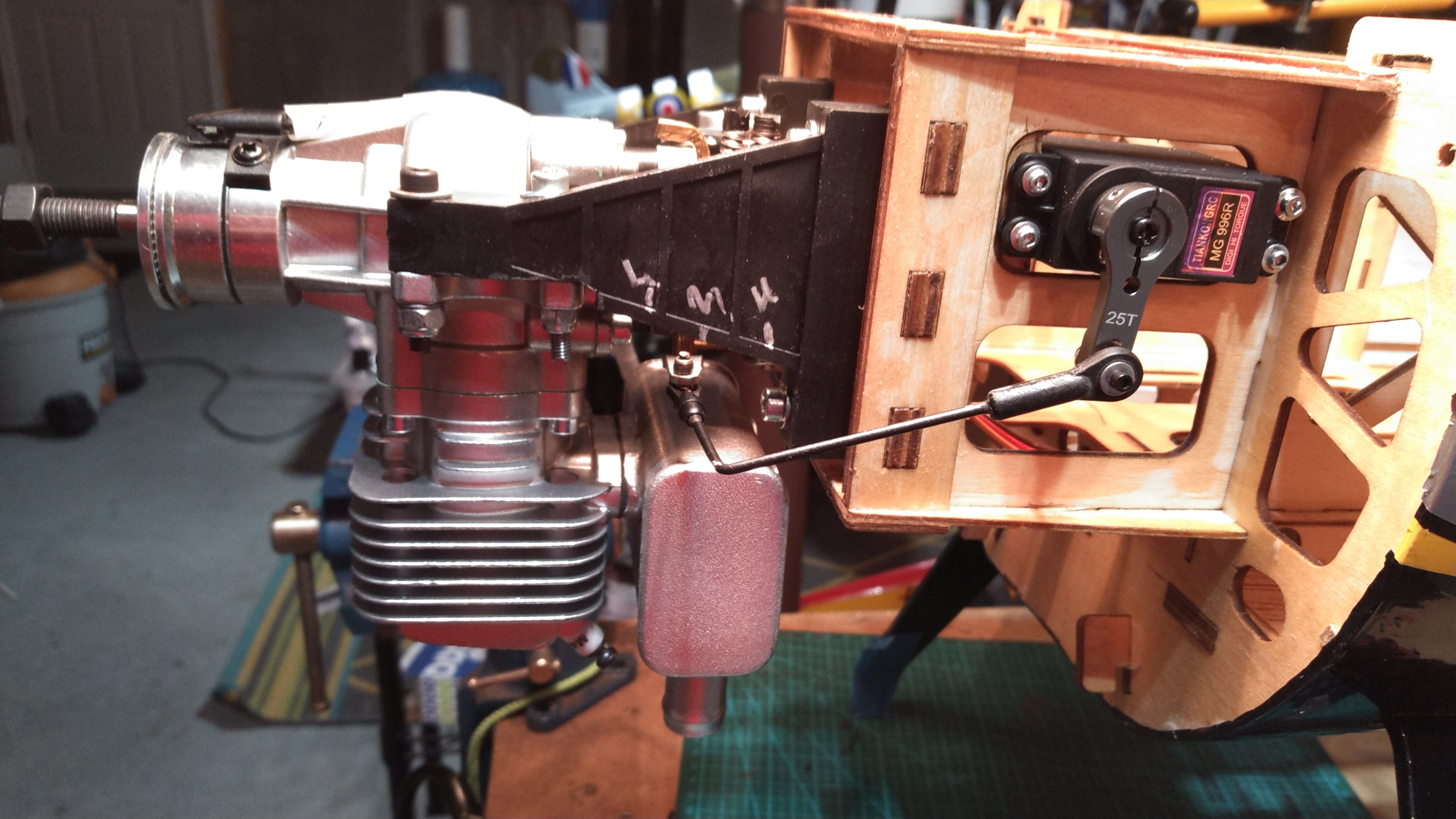


The throttle servo set up I had to rig. Works well. My notations on the rail mark the WOT, middle and stop throttle positions I used to set mid throttle on the servo. I had to make the opening smaller for the servo so it would secure correctly.


One of those design issues. The cowl bolt heads are inside the cowl, I don’t have a hex screw driver long enough. Also, the way the cowl is set on it has to come up from underneath a bit and gets pushed up into place, so this really is the only way. I need to figure something out.


Perfect center. You can see the cowl mount bolts inside the upper right and left sides. Putting s 2.5 inch aluminum 3 blade spinner over the Master Airscrew 15x7x3 prop, after breaking it in with a MA Scimitar 2 blade.


The rudder pull-pull system.


The underside of the lower wing, the center of which is where I laid down the fiberglass  under the AMA sticker. Came out nicely. Painted the control rods flat black, the stock white was just wrong.


The big M4F sparky doesn't hold onto the RCExcel ignition spark plug wire (neither does the CM6 I tried). I  set up the cowl cut-outs to allow part of the cowl to hold it in place.


The  cowl cut-outs for the muffler pipes and the tip of the spark plug wire. 
Painted the aft part flat black.


Internal electronics layout, the battery not in place. Spektrum AR637T receiver, Tech Aero UBEC that filters noise from the ignition nd is the ignition on-off switch, the flag-pun powerswitch, the rudder servo. Underneath is the voltage regulator taking the 7.4V battery packmdown to 6.6V.


The underside, above the wing. Wiring and the voltage regulator.


The Ignition LED and the flag-pin fail-on reciever power switch.  Works perfectly! Wonder how long before I snap the pin off...


The backside of the flag-pin switch. I added some support to the fuselage balsa to support use of the switch. Battery pack. Imhad to search for some time before I found this flag-and-pin fail-on switch at RadicalRC, one designed to not to need a power regulator system, but to act as  primary switch. 


Very clean electronics bay. Missing the fuel tank still. It will be mounted to the port side forward of the receiver. One antenna horizontal, one vertical.


Tech Aero UBEC lateral to the 2S 7.4V 5200 mAh LiPO battery pack.


The RCGF-USA Stinger Engines sticker, one on each side. 
Thanks Joe at RCGF-USA! I add the weblink.

Tomorrow the fuel tank will arrive. I need to solve the cowl bolt problem.
 

Friday, July 30, 2021

Nitroplanes Pitts Model 12 20cc Build Continues

The joy continues!  The past couple of days have seen some progress. Here's some work over the pat couple of days.


Put the wheel struts on. These babies are some sturdy underpants. The kit comes with some really good quality upper fairings that are made of fiberglass. I wish the Phoenix Waco had come with something like these. There's some rubber tubing to use along their edges. More on that when I install them.


Sorta on her legs. Won't put the wheels and pants on for now.


This is the Pitts next to the 20cc Phoenix Waco. When the cowling goes on she will be several inches longer.


I permanently joined the lower wing halves.


On an aside I painted the tips of the Master Airscrew 15x7x3 prop I have on hand. This is the same one I use on the PulseXT with its 20cc engine. 


Aileron servos are all on their hardpoints ready to install. These generic servos are really amazing quality.


I didn't do this with the Waco, but the YouTube video of the Pitts with a 20cc engine shows the canopy popping off despite the latch. This suggests there is some kinda internal air pressure, so I decided to put a exit vent on the back underside. I had one from a previous build hanging around.


With that "popping off of the canopy" I also wanted to add a couple strong magnets to help secure it.


That's them in the corner. 


I don't have a lot of faith in wings joined with a short wood beam rather than a wing tube, because one of my PulseXT 40's folded like a diaper pulling out of an easy loop. Since then any design with that I tend to want to put a couple layers of thin fiberglass on the underside. I peeled back the cote, taped it off, sanded it (there was an epoxy sine from the joining seen here).


Sanded smooth.


I used 15 min epoxy thinned with alcohol, painted the wood with it, laid down a sheet of fiberglass cloth, layered it with more epoxy, laid the second sheet, and more epoxy. Smoothed it out.
 Letting it dry. Once it's dry enough I will cut the edges clean and pull the tape, let it dry a day or two, then cote it after a light sanding.


This is the fine fiberglass cloth I used. It is kinda hard to work with in that it un-weaves with even the slightest traction.

Today the RCGF-USA 20cc engine arrived today! I am expecting the ZYHobby fuel tank, and the rudder and elevator servos to arrive today as well, along with the voltage regulator, so I hope to make some progress. It will be a few days before the flag-and-pin switch arrives.

RCGF-USA 20cc RE Engine!

 OH! LOOKIE HERE! Look what Mr. Mailman brought me today! This is going in the Pitts 20cc build.

Quick shipping from Joe and Pam Nelson at RCGF-USA. Happy, happy, joy, joy!


What a nice looking box.


I asked Joe for some RCGF-USA Stinger stickers to use on this build, as I couldn't find them on the site. Since I have worked with him for almost a decade he kindly threw these in. The skull is going on the wing, and the scorpions on the sides. Very nice!


Always well packed. Even at this stage the the amazing quality of these genuine RCGF-USA engines is impressive. If you haven't tried them, you are missing out on the bet prices for really quality built engines that are powerful and reliable.


Look at that. LOOK AT IT! IT'S FRICKIN' AMAZE-BALLS!
Totally excited to be using this engine on this build.

Thursday, July 29, 2021

Nitroplanes Pitts Model 12 20cc Build

Surfing Facebook the other day, I ran across an offer I could not refuse, and picked up a 15cc sized Nitroplanes Pitts Model 12, in the color scheme option I preferred (don't like that blue one). I decided to binge a bit, and have made a few parts purchases, making me pace myself as they come in. What I love about this plane is that its a bit bigger at 15cc sized aerobat, its a bipe, it has an ultimate wing, and a round cowl. Love this look! This model came with no manual, which from what I found online is fine as the manual was ripe with mistakes and misguidance. Its kinda fun doing this build using just my own experience and knowledge, dare I say, skills.


One version of the real plane.


This is the model's Python scheme. I am not planning on ordering the Python graphics since I don't really care if its scale, I just want to fly it. I will personalize it though! I am hoping Joe Nelson sends me some RSCF-USA Skull Logo stickers.


I started by fuel-proofing the anterior fuse. I did most of the interior, all sides, not just for the fuel proofing, but also to add some tensile strength. I use 15 min epoxy diluted out with alcohol and brush it on thinly.


After several careful dry fits and increasing the gap of the hinge slots, I epoxied in nylon Du-Bro hinges. I prefer the strength on gassers, although the provided CA hinges would work. I have never had a nylon hinge loosen, but several CA hinges, so I tend to avoid them.


Since the horizontal stabilizer could be installed either side up, I opted with the star side up. Not sure what the real Python has displayed. Here the horizontal stab and rudder are installed, all with the nylon Du-Bro hinges. I used the larger ones on the rudder since it also takes some of the forces from the tail wheel.


Installed the tail wheel. It is the standard design with the gear "tiller" end attached into a hole I drilled into the rudder providing yaw force to the tail wheel, and added epoxy support along the attachment to the rudder. There is CA in that hole securing the "tiller", and epoxy around the exposed part contacting the front of the rudder. I open the cote under that metal support, CA, then double screw: screw in the retaining screw, unscrew it and apply CA then re-insert it. That thing is secure.

Here are some of the coming parts.


Master Airscrew 15x7x3 prop. I happen to have one on hand. Painting the tips yellow with a black middle stripe. Love these props. Durable with great performance. I have a 14x7 Master Airscrew Scimitar coming that I will use to break in the engine. I also have a 2.75in aluminum 3 blade spinner coming from ZYHobby on eBay coming.


RCGF-USA 20cc RE engine.  I am a total RCGF-USA Fanboy. This plane is described as "70 class", inferring a 0.7 cu in or roughly between 10 and 15cc sized plane (0.6 cu in is 10cc). I like a little power, and another builder put a 20cc engine in the plane with excellent results. I am trying to get away from engines less than 15cc since their carbs are a pain to manage, so, bought a new engine from Joe Nelson at RCGF-USA. Always the best personal support on the best and most affordable engines that run reliably and awesomely. Really excited about this engine!


I have on hand:


Tech Aero Designs UBEC.  (Manual here). This takes power through the receiver and acts as a remote ignition cut-out switch. It also protects the receiver from any hardwire ignition noise. I don't use a mechanical ignition switch (see below).

Step down voltage regulator.  I will be using the 2S (7.4V) 5300 mA battery from the Ultra Stick in this plane. The servos are not high voltage, so it will need a step down to 6.6V. 


DS3218 Digital RC Servo Motor 20KG High Torque Full Metal Gear. This plane has 4 aileron surfaces, each driven by its own servo, which is a bit overkill, but good for a high powered aerobat. Using a 20kg high torque servo just adds more power to these surfaces. Each side will require a Y-harness to the receiver. This was a 4 pack, convenient. I have had very good results with generic servos.


Since I had to order 2 more servos (I have a throttle servo), I bought this 2 pack of high torque servos, one for the rudder (a pull-pull setup), and one for the elevator.

Spektrum AR637T Receiver.  I had bought this with other plans for it, and have had it on hand for over a year, NIB. I decided its a good fit for this plane. I will be programming the AS3X, but won't be using SAFE. The ailerons will be Y-harnessed to AIL and AUX1, each of the other servos will of course have their own channel. GEAR will be used for the Tech Aero Ignition UBEC/Cut out.

The remaining decision it the receiver power switch. I have had mechanical switches fail, never in flight, just not working one day, on a couple of occasions. I don't feel the need for redundant systems, though I appreciate their application in larger planes. What I wanted was a simple flag-and-pin style fail-on switch. I found one that was $60 (see below, from Australia), that was a simple stand alone switch, not one like DUALSKY or Smart-Fly redundancy bus systems. Why no one else makes a simple affordable switch capable of handling the battery pack voltage and amps is beyond me, I think there is a good market for one.  

\

My idea had been to take one of these (Left is DUALSKY, right is Smart-Fly) as an inline on-off switch, placing it on the negative side of the battery lead. They are not designed for that, instead are designed for microamp signals to a power control system. A couple of experienced folks (Thanks Cody Wojcik and Jerry Leach) felt they probably would NOT handle the amps. The gauge of the wire isn't the issue, its the internals of the switch itself that are of concern. Bummer. Someone needs to make one that is just simple but can carry the volts and amps of the battery pack. 


This one from Australia (the ONLY place I can find one) is expensive, and shipping almost doubles the cost. Its pretty much exactly what I need, though a simple switch and LED without the expensive switch plate is more my desire. I would build one myself, but I can't find the damn switch. I want one that I remove the pin, not place one, to power the circuit. I could easily make one that plugged in to power on, I want one to power on when I remove the pin. I welcome ideas!

The wing servos are arriving today from Amazon, so I will start on the wings. The top wing is one piece, 54" in wingspan. This creates a transport problem as it isn't going to fit in my car nor my wife's SUV attached to the fuse. The bottom wing is two piece joined in the middle. I will need to remove the wings to transport it. Since the top wing is one piece, and the bottom wings two parts are joined in the middle, I plan to permanently join the two bottom halves, epoxying the wing spar in place, and putting a thin fiberglass layer on the top and bottom of the wing at the wing joint. Since I have to use a large wing bag for the top wing, I might as well make the bottom wing one piece as well. Adds strength, and makes transport a tad easier. What this leaves is a LOT of tiny screw and nylock nuts that need to be put on and taken off with every transport. I will need to carry a bag of replacements, as those damn things will disappear like chocolates at a sorority house.

I haven't heard from Horizon Hobby about my iX12 transmitter, which is there for service.  Its there, and hopefully I will hear something this week. They have such great service and turn around is really quick.

More to follow!

UPDATE: I did find this flag-and-pin switch from RadicalRC for $11 plus reasonable shipping:


I don't understand RadicalRC "generally not recommending its use in high vibration environments" since its a "single contact" switch due to lack of redundancy. All switches are single contact. These ARE used with powersafe systems as the sole switch in high vibration aircraft (ie gassers), so I don't understand why they wouldn't. I'm going to give it a shot.